Logan Green
In Cold BloodLogan Green, a Kentucky-born veteran criminal lawyer known for theatrical timing, became the state’s principal courtroom advocate in the trial of Richard Hickock and Perry Smith. Although he usually defended criminal cases, Kansas retained him to support the inexperienced county attorney, Duane West. Green’s work joined legal argument to performance: he contested psychiatric scrutiny of the defendants, tested witnesses whose testimony bore on Hickock’s connection to the Clutter farm, and closed by urging the jury to impose death.
Background and Appointment
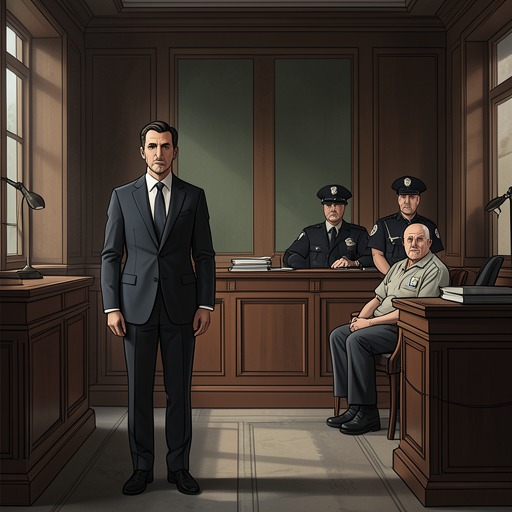
Green was a short, pugnacious man in his seventies, freckled enough as a boy to acquire the nickname Pinky. His professional reputation rested partly on stagecraft: he understood timing and could command an audience without notes. The state’s decision to bring him into the prosecution reflected concern that West lacked the experience to handle a case of this scale without assistance. Green’s unusual position as a customary defense lawyer arguing for the prosecution gave his courtroom role an added contrast, but the account presents his assignment as a practical response to the demands of the trial.
The Question of Psychiatric Examination
Soon after the defendants’ arraignment, defense counsel asked Judge Tate to send them to Larned State Hospital for comprehensive psychiatric examinations. The proposed evaluation would determine whether either man was unable to understand his position or assist in his defense. Green opposed the request. He anticipated that the defense would rely on temporary insanity and feared that psychiatrists sympathetic to the accused would testify for them. He argued that Kansas followed the M’Naghten rule: a person who understood the nature of an act and knew it was wrong remained legally responsible. In his view, state law did not require specialists; local general practitioners could assess sanity, as they did in other county proceedings.
The defense countered that two lives were at stake and that trained specialists should examine the men. Green’s objection therefore carried more than a procedural consequence. It set a local standard of legal competence against the defense’s appeal to developing psychiatric expertise. The dispute also exposed competing ideas about what the trial should establish: whether the defendants met a traditional legal test of responsibility, or whether their mental conditions required a more specialized inquiry. The available account establishes Green’s opposition and his stated concern about the defense strategy, but does not make him the authority who resolved the issue.
Witnesses and Cross-Examination
Green guided the state’s presentation of Floyd Wells, the former cellmate whose information had helped lead investigators to the defendants. Because Wells was still serving a sentence at the Kansas State Penitentiary and might face retaliation, he had been moved to a small jail in a neighboring county before testifying. Green’s questions drew out Wells’s earlier work as a hired hand at River Valley Farm and his later prison friendship with Hickock. Wells said that he had described Herbert William Clutter and the farm to Hickock, including the family’s wealth, while Hickock was discussing a possible western job after parole. Green’s questioning thus connected Wells’s firsthand knowledge of the farm with Hickock’s expressed interest in it.
Defense attorney Arthur Fleming pressed Wells on why he had not discouraged Hickock after hearing about violent plans. Wells answered that he had not believed Hickock would act. Later, Harrison Smith questioned Wells about the newspaper reward and asked what immunity the county attorney had offered him. Green objected that no testimony had established an immunity arrangement; Judge Tate sustained the objection. Hickock accused Wells of expecting to collect the reward and escape punishment. The narrative reports that Wells later received both the reward and parole, a result that gave force to Hickock’s courtroom accusation without establishing that Green had promised him immunity.
Green also cross-examined Walter Hickock, Richard Hickock’s father, about his account of his son’s changed behavior. When Walter placed the change after 1950, Green brought out that his son had been arrested in 1949. He then challenged the implication that Hickock had lost his criminal tendencies. The question provoked laughter in court, which Judge Tate quickly checked. Green’s intervention used a concrete discrepancy in the father’s chronology to undermine the picture of a sudden later transformation.
Closing Argument and Trial Role
As the state’s special assistant, Green followed the defense appeals for mercy with a closing argument built around the victims and the consequences of acquitting or sparing the defendants. He invoked the Clutter family’s deaths to oppose the defense’s religious and moral objections to capital punishment, then cited biblical passages addressing unlawful killing and its penalty. His use of scripture was also theatrical: he appeared to lose his place before continuing from memory, a courtroom maneuver that drew knowing amusement from visiting lawyers.
Green warned the jurors that leniency could expose other families to future violence, and urged them to regard the maximum penalty as a duty rather than vengeance. His appeal worked through contrast: the defense framed execution as a further taking of human life, while Green framed mercy as a risk borne by the community and the victims’ families as the measure the jury should not forget. The speech impressed some listeners as masterly, but a reporter criticized it as inflammatory and brutal. Green’s significance in the trial lies in that double-edged command of the courtroom: he could turn legal distinctions, witness contradictions, and religious language into a forceful public case, while the performance itself remained open to criticism.